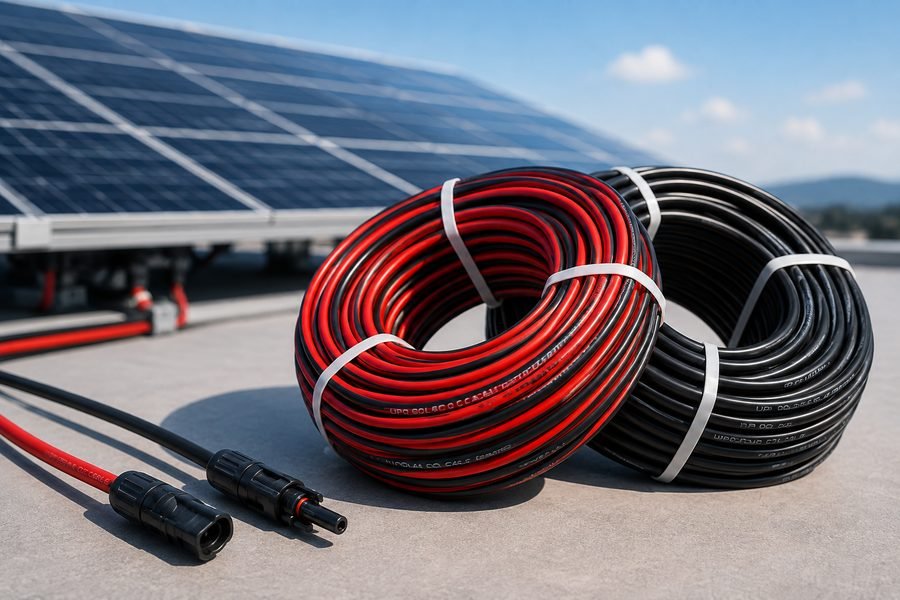
A rooftop solar cable lives a harder life than almost any other wire on a property. It's mounted outdoors, exposed to direct sun and UV for years, cycles through extreme temperature swings daily, and carries DC current under conditions ordinary PVC-insulated wire was never designed for. That's exactly why solar DC cables are held to a separate set of standards.
Why Solar Cables Need Different Standards
Standard building wire insulation degrades relatively quickly under constant UV and thermal cycling — it wasn't designed for permanent outdoor exposure. Solar arrays also introduce sustained DC current, which behaves differently from the AC current most insulation and connector standards are built around. Cables that aren't rated for this combination can crack, degrade, or fail well before the 25+ year lifespan a solar installation is meant to deliver.
What IS 17293 & IEC 62930 Actually Cover
These standards define the testing and construction requirements specifically for photovoltaic DC cables — things like resistance to UV degradation, thermal endurance, insulation performance under sustained voltage, and mechanical durability. A cable carrying this compliance has been tested against conditions that mirror real rooftop exposure, not just general-purpose wiring conditions.
Why It Matters Beyond the Spec Sheet
- Warranty validity — solar installers and system warranties typically require compliant cabling; non-compliant cable can void coverage
- System safety — DC arc faults behave differently from AC faults, and non-rated insulation increases fire risk
- Long-term performance — degraded insulation increases resistance and energy loss across the array over time
- Installer accountability — using compliant cable is part of doing the installation to code, not just a preference
What to Look For
UPD's Single Core Solar DC cables are built for exactly this environment — cross-linked, halogen-free XLPO insulation, available in 4 sqmm, 6 sqmm, and 10 sqmm, compliant with IS 17293 and IEC 62930, and rated for a 25-year service life to match the expected lifespan of the solar array itself. When you're sizing a system, the cable should be speced with the same seriousness as the panels and inverter — it's the part of the system that's hardest to inspect or replace once installed.